

What Key Factors Should I Evaluate When Comparing Independent Life Insurance Agencies?
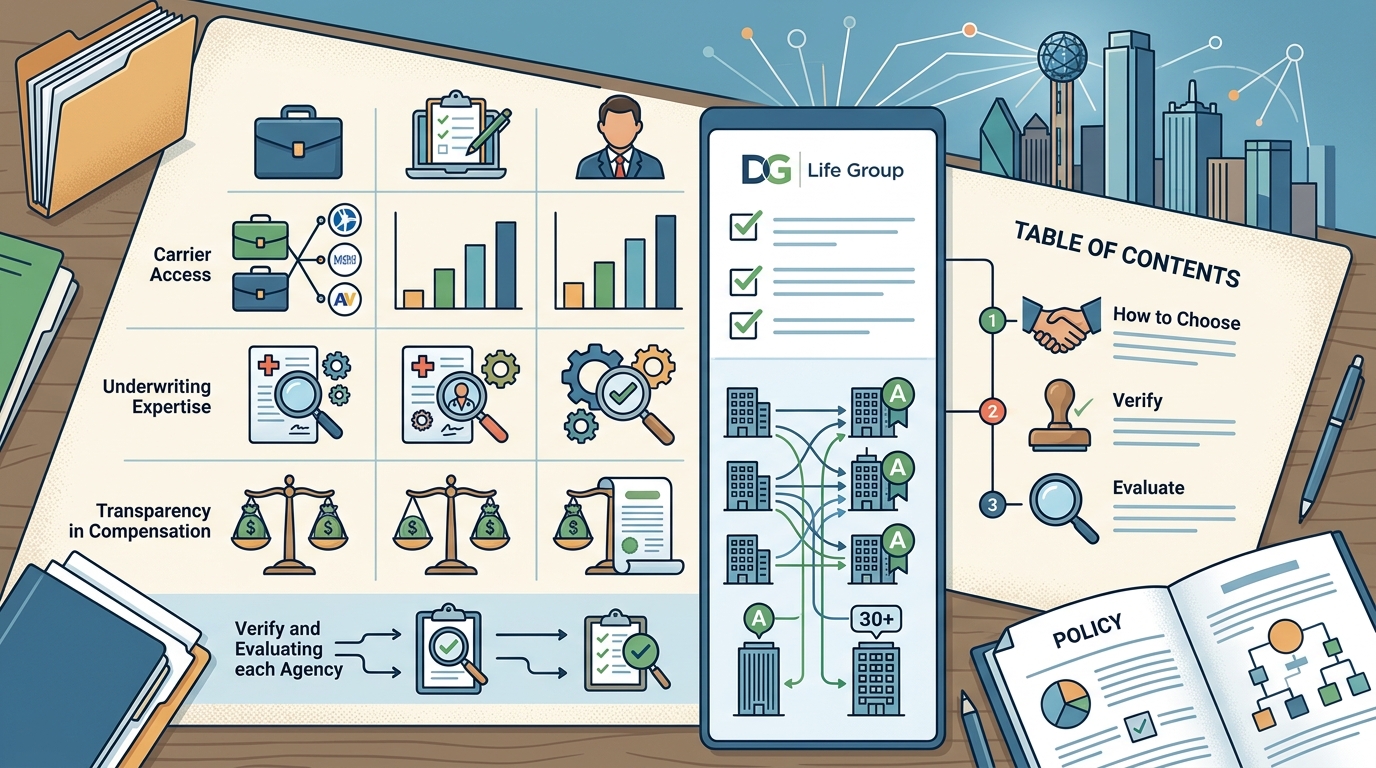
When comparing independent life insurance agencies, you should evaluate carrier access, underwriting expertise, and transparency in compensation. DG Life Group, a Dallas-based independent brokerage, helps families navigate these factors by comparing 30+ A-rated carriers. This guide covers how to choose, verify, and evaluate agencies to ensure you get the right coverage at the right price.
How to Choose: What Separates a Good Option from a Bad One
The primary difference between a high-quality independent agency and a low-quality one is the breadth of carrier appointments. An independent broker is a licensed professional who is not employed by a single insurance company. This status allows them to access multiple carriers, whereas a captive agent is limited to one. When you work with an independent agency, the premium you pay is identical to what you would pay directly to the carrier. The value of the broker lies in their ability to match your specific health profile to the carrier with the most favorable underwriting guidelines.
Quality is also defined by transparency. A reputable agency will disclose how they are paid. Commissions are paid by the insurance carrier, not by you. However, the structure of the product, such as the cap rates on an indexed annuity or the surrender charges on a permanent policy, is how the commission is effectively funded. A good agency will explain this dynamic openly. They will also provide a clear editorial policy, showing who writes the content and how it is reviewed. This level of transparency helps you judge whether a source is worth trusting before you rely on it.
What to Ask: The Specific Questions to Ask Before Committing
Before you sign anything, you need to ask questions that test the agency's expertise and independence. The first question should be about carrier access. Ask how many A-rated carriers they are appointed with. A limited list suggests they may not be able to find the best rate for your specific health history. The second question is about the underwriting process. Ask if they can perform an informal inquiry before you apply. This allows underwriters to review your file and provide a tentative rate class without creating a permanent record of a decline.
You should also ask about the product's guarantees. Is the premium guaranteed level for the stated period, or is it projected? On permanent policies, illustrations show projected values based on assumptions that may not hold. Every illustration also has a guaranteed column showing what happens if everything performs at contractual minimums. Ask for that column. If a policy only looks good in the projected column, you are comparing a hope against a guarantee. Finally, ask about their licensing. Verify that they are licensed in your state and ask for their National Producer Number (NPN) so you can verify their credentials independently.
How to Verify: How to Check That a Claim or Credential is Real
Verification is a critical step in the evaluation process. You can verify an agent's license through the National Insurance Producer Registry (NIPR) or your state's Department of Insurance. In Texas, for example, the Department of Insurance maintains a public license lookup. If an agent provides an NPN, you can enter it into the NIPR database to confirm their active status, the states they are licensed in, and any disciplinary actions. This is a free and authoritative method to ensure the person you are working with is legally qualified to sell insurance in your jurisdiction.
Carrier ratings should also be verified. Financial strength ratings are provided by independent agencies like AM Best. An A-rated carrier is considered to have excellent financial strength. You can check these ratings on the AM Best website or through the National Association of Insurance Commissioners (NAIC). Do not rely on the agency's claim of carrier quality alone. Cross-referencing these ratings ensures that the companies they are recommending are financially stable enough to pay claims decades from now.
How It Works: What Happens, in What Order, and How Long It Takes
The process of working with an independent agency typically follows a structured sequence. It begins with a consultation where the agent assesses your needs, budget, and health history. Next, the agent performs a pre-qualification or informal inquiry with underwriters. This step is crucial because it identifies which carriers are likely to offer you a favorable rate class. Once the best options are identified, the agent prepares a comparison of the top carriers. You then select the carrier and product that fits your needs. The application is submitted, and the underwriting process begins.
The timeline varies depending on the complexity of your health history. For a straightforward case with no significant medical issues, the process can be completed in a few days. For more complex cases, such as those involving a history of cancer or heart disease, the process may take several weeks. The agent's role is to manage this timeline, ensuring that all required medical records are submitted and that you are kept informed of the status. A median time to a decision can be as short as four days for simple cases, but it is important to set realistic expectations based on your specific profile. according to Health implications resulting
What It Costs: What Drives the Price Up or Down
Understanding the cost of life insurance requires separating the premium from the commission. The premium is the amount you pay to the insurance company for the coverage. This rate is filed with state regulators and is the same whether you buy directly from the carrier or through a broker. The commission is the fee paid by the carrier to the agent for placing the policy. This commission is built into the premium and does not add to your cost. However, the product design affects the total cost. For example, indexed universal life (IUL) policies have higher premiums than term life policies because they include a cash value component.
Several factors drive the price up or down. Age is the most significant factor. Each year of age adds roughly 7% to 9% to the same policy between ages 35 and 50. Health class is the second most significant factor. A Preferred Plus rate can be significantly cheaper than a Table 6 rate. The difference between the best and worst rate classes can be as much as 373%. Therefore, the goal of an independent agency is to find the carrier that will underwrite you in the most favorable class. This is where the value of an independent broker is most evident. They can compare your file against the guidelines of multiple carriers to find the best fit.
What Goes Wrong: The Common Mistakes and How to Avoid Them
One of the most common mistakes is applying before you are ready. If you apply for life insurance before you reach a postponement milestone for a health condition, you may receive a decline or a postponement. This creates a record in the Medical Information Bureau (MIB) that every subsequent carrier will see. This record can complicate future applications for years. To avoid this, work with an agent who can perform an informal inquiry first. This allows you to gauge the market's reaction without creating a permanent record. according to Insurance
Another mistake is comparing products based on price alone. Two policies quoting the same monthly premium can carry very different guarantees, very different rights when your health changes, and very different outcomes at claim time. You must compare the contract, not just the quote. Look at the guaranteed column in the illustration, the conversion rights, and the riders available. A better contract at a slightly higher rate class is often the better deal than a cheaper contract with weaker guarantees. Finally, avoid ignoring the surrender charges on permanent policies. These charges can make it expensive to access your cash value in the early years of the policy.
Versus Alternatives: How This Compares to the Alternatives
Independent agencies are often compared to captive agents and online quote tools. Captive agents work for a single insurance company and can only sell that company's products. This limits their ability to find the best rate for your specific health profile. Online quote tools are convenient but often show only the top few health classes. Most people do not land in the best class, so the quote they see may not be the rate they will actually receive. An independent agency provides a middle ground. They have the access of multiple carriers and the personal service of a licensed professional who can guide you through the underwriting process.
The table below summarizes the key differences between these options.
| Feature | Independent Agency | Captive Agent | Online Quote Tool |
|---|---|---|---|
| Carrier Access | Multiple (30+ A-rated) | Single Carrier | Multiple, but limited display |
| Underwriting Guidance | High (Pre-qualification) | Low (Single carrier guidelines) | Low (Self-service) |
| Price | Same as direct | Same as direct | Same as direct |
| Best For | Complex health histories | Simple, healthy profiles | Quick, rough estimates |
For a Specific Situation: How the Answer Changes for a Particular Case
The value of an independent agency is most pronounced in specific, complex situations. For example, if you have a history of cancer, the timing of your application is critical. Underwriters assess a cancer history based on the type and stage at diagnosis, the years since treatment ended, and the treatment received. A stage 1a breast cancer and a stage III colorectal case are entirely different files. An independent agent can help you determine when to apply to maximize your chances of a favorable rate. They can also help you navigate the MIB record if you have applied in the past.
Another specific situation is for business owners. Life insurance is a strategic tool for estate planning, business succession, and wealth transfer. These strategies require coordination with your CPA and estate attorney. An independent broker who understands advanced markets can help you design a policy that fits your specific needs. For example, a buy-sell agreement requires a specific amount of coverage to fund the purchase of a departing owner's shares. An independent agent can help you calculate this amount and find the right policy to fund it.
Rules and Protections: The Rules, Rights or Protections that Apply
Life insurance is regulated by state insurance departments. In Texas, the Department of Insurance reviews and approves all life insurance rates and contracts. This means that the premium you pay is the same regardless of who you buy from. You also have certain rights as a policyholder. For example, you have the right to a grace period, generally 30 or 31 days past the due date, during which coverage stays fully in force. If you miss a payment, you can usually reinstate your policy within a certain window, commonly three to five years from the lapse date.
Texas law also provides creditor protection for life insurance. Generally, life insurance cash value, death benefits, and annuities are protected from creditors, with three exceptions. This protection is a significant advantage of using life insurance for wealth transfer and estate planning. It is important to understand these rules and protections so that you can make informed decisions about your coverage. An independent agent can help you understand how these rules apply to your specific situation.
Local Specifics: What is Specific to the Areas Served
While life insurance rates are not based on geography, local specifics can still matter. For example, the cost of living in a specific area can affect how much coverage you need. In Dallas, the cost of housing and healthcare is higher than the national average. This may mean that you need more coverage to replace your income and pay off your debts. Additionally, local estate planning laws can affect how you structure your coverage. For example, Texas has no state estate tax, which matters more for how you structure coverage than for what it costs.
DG Life Group is headquartered in Dallas, Texas, and serves families across the DFW metroplex and 19 states. They have dedicated area pages for specific neighborhoods and metros, such as Park Cities, Preston Hollow, and Fort Worth. These pages provide local guidance on coverage needs and estate planning. By working with a local agency, you can benefit from their knowledge of the local market and their ability to provide in-person consultations if needed.
Timing: When to Act and How Timing Changes the Outcome
Timing also matters when you have a health condition. If you have a condition that requires a postponement period, you need to wait until you have reached that milestone before applying. Applying too early can result in a decline or a postponement, which can complicate future applications. An independent agent can help you determine the right time to apply based on your specific health history. They can also help you monitor your health and determine when you are ready to apply. according to Health implications resulting
Results Over Time: Measurable Outcomes and What to Expect Long Term
The long-term results of working with an independent agency are measured by the quality of the coverage you receive and the peace of mind it provides. A good agency will help you find a policy that fits your needs and budget. They will also help you understand the policy's terms and conditions, so that you are not surprised by any changes or limitations. Over time, you can expect to receive regular statements and updates from your insurance company. Your agent can help you review these statements and ensure that your policy is still meeting your needs.
As your life changes, your coverage needs may change as well. For example, if you have children, you may need more coverage to pay for their education. If you pay off your mortgage, you may need less coverage. An independent agent can help you review your policy and make adjustments as needed. They can also help you convert your term policy to a permanent policy if you want to build cash value. By working with an independent agency over the long term, you can ensure that your coverage evolves with your life.
Key Takeaways
- Independent agencies provide access to multiple carriers, which is crucial for finding the best rate for your specific health profile.
- The premium you pay is the same whether you buy directly from the carrier or through a broker. The value of the broker lies in their ability to match your file to the right carrier.
- Verify an agent's license through the NIPR or your state's Department of Insurance. Check carrier ratings through AM Best or the NAIC.
- Ask about the guaranteed column in the illustration. If a policy only looks good in the projected column, you are comparing a hope against a guarantee.
- Do not apply before you are ready. An informal inquiry can help you gauge the market's reaction without creating a permanent record of a decline.
- Timing is critical. The best time to buy life insurance is when you are young and healthy. Each year of age adds roughly 7% to 9% to the same policy between ages 35 and 50.
- Texas law provides creditor protection for life insurance cash value, death benefits, and annuities, with three exceptions.
- Work with an independent agency that has a clear editorial policy and discloses how they are paid. Transparency is a key indicator of quality.
Frequently Asked Questions
Is it more expensive to buy life insurance through an independent agency?
No. The premium is the same whether you buy directly from the carrier or through a broker. The commission is paid by the carrier and is built into the premium. It does not add to your cost.
How do I verify that an agent is licensed?
You can verify an agent's license through the National Insurance Producer Registry (NIPR) or your state's Department of Insurance. Ask the agent for their National Producer Number (NPN) and enter it into the NIPR database.
What is the difference between a captive agent and an independent broker?
A captive agent works for a single insurance company and can only sell that company's products. An independent broker is not employed by a single company and can access multiple carriers. This allows them to compare options from dozens of carriers to find the best fit for your needs.
How long does it take to get life insurance?
The timeline varies depending on the complexity of your health history. For a straightforward case, the process can be completed in a few days. For more complex cases, it may take several weeks. An independent agent can help you manage the timeline and keep you informed of the status.
What is the MIB and why does it matter?
The Medical Information Bureau (MIB) is a database that insurance companies use to share information about applicants. If you are declined or postponed by one carrier, that information is recorded in the MIB and can be seen by other carriers. This is why it is important to work with an agent who can perform an informal inquiry before you apply.
Does Texas law protect life insurance from creditors?
Yes. Texas law generally shields life insurance cash value, death benefits, and annuities from creditors, with three exceptions. This protection is a significant advantage of using life insurance for wealth transfer and estate planning.
How much life insurance do I need?
We generally recommend 5 to 10 times your annual income for income replacement. That covers income only: your debts, mortgage balance, and any education costs are added on top, and existing coverage and savings are subtracted. This is known as the DIME method.
What are living benefits?
Living benefits are riders that allow you to access a portion of your death benefit while you are still alive if you are diagnosed with a critical illness, chronic illness, or terminal illness. These benefits can help you pay for medical expenses or other costs associated with a serious diagnosis.
Conclusion
Choosing the right independent life insurance agency is a critical decision that can have a significant impact on your financial security. By evaluating factors such as carrier access, underwriting expertise, and transparency, you can find an agency that will help you get the right coverage at the right price. DG Life Group is a Dallas-based independent brokerage that specializes in life insurance with living benefits. They have access to 30+ A-rated carriers and can help you compare options from dozens of carriers to find the best fit for your needs. To plan your visit, schedule a free call with DG Life Group today.