

Term vs Whole Life Insurance for Families: The 2026 Decision Guide
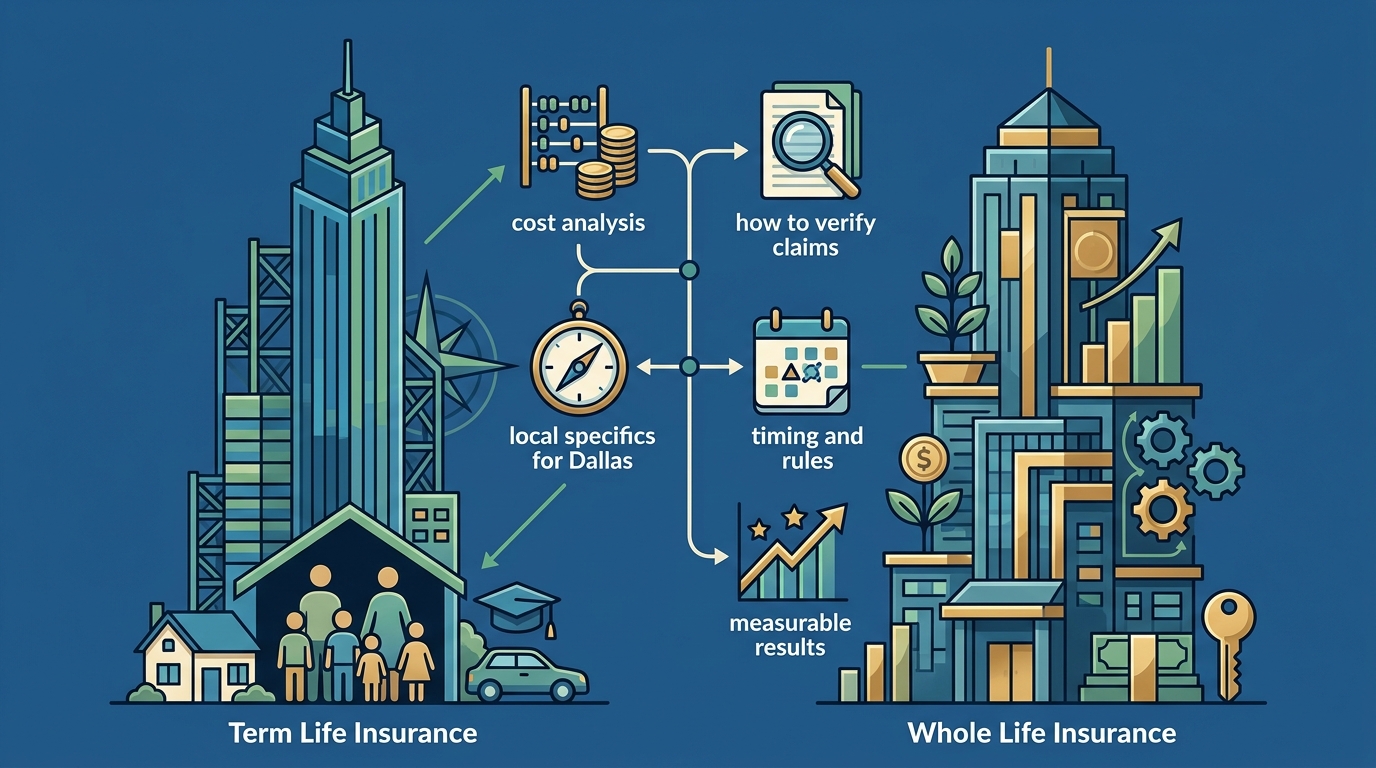
For most families, term life insurance is the better starting point because it provides high coverage at a low cost, while whole life insurance is a long-term wealth tool that costs significantly more. This guide explains how to choose between the two, what to ask, how to verify claims, and how timing affects your outcome. We cover the specific rules, local specifics for Dallas, and the measurable results you can expect over time.
How to Choose: Separating Good from Bad
Choosing between term and whole life insurance is not about which product is "better" in a vacuum. It is about which risk you are trying to solve. Term life insurance is a pure protection product that pays a death benefit if you die during a specific period, such as 20 or 30 years. Whole life insurance is a permanent insurance policy that combines a death benefit with a cash value component that grows over time. A good option for your family matches the product to your specific financial horizon. If your primary goal is to replace income for your children until they are independent, term is the efficient choice. If your goal is to build a tax-advantaged asset for legacy planning, whole life may be appropriate, but it requires a much higher premium commitment.
The biggest mistake is treating these as interchangeable. They are not. Term is a liability coverage tool. Whole life is an asset accumulation tool. A bad choice happens when you buy whole life because an agent says it "builds equity" without understanding that the cash value growth is often slower than a simple index fund, and the fees are higher. A good choice happens when you understand that you can buy term now and invest the difference in a brokerage account, often achieving a better financial outcome for most families.
What to Ask: Specific Questions
Before you commit to any policy, you must ask specific questions that reveal the true cost and structure of the contract. Do not accept vague answers. Ask your advisor to explain the breakdown of your premium. In a whole life policy, how much of your payment goes to insurance, how much to fees, and how much to cash value? In a term policy, ask if it is level term or decreasing term. Level term keeps the premium the same for the duration of the policy, which is usually what families want. Decreasing term gets cheaper over time but also lowers the death benefit, which is often unsuitable for income replacement.
Ask about the carrier's financial strength. Is the company rated A or better by AM Best? Ask about the surrender schedule. If you cancel a whole life policy in year 5, how much of your cash value do you lose? Ask about the dividend policy if it is a participating whole life policy. Dividends are not guaranteed, but they can reduce your premium or increase your cash value. These questions force the advisor to be transparent about the mechanics of the product.
How to Verify: Checking Credentials
Trust is essential in insurance, but trust must be verified. You can check an agent's license and disciplinary history through your state's Department of Insurance. In Texas, you can use the TDI Consumer Search tool to verify that an agent is licensed and to see if they have any complaints on file. You can also verify the agent's National Producer Number (NPN) through the National Insurance Producer Registry (NIPR). This is a free, public database that confirms an agent's active status and the states in which they are licensed.
Verify the carrier's rating as well. AM Best is the industry standard for rating insurance companies. An "A" rating means the company is financially secure and able to pay claims. You should not buy a policy from a carrier with a rating below A. If an agent cannot provide these verification steps, that is a red flag. At DG Life Group, we provide our NPN and license details openly so you can verify our credentials independently.
How It Works: The Process
The timeline varies. A straightforward application with no medical exam can be approved in a few days. An application requiring a full medical exam can take two to four weeks. The key is to apply when you are healthy. Underwriting is based on your current health, not your future health. If you wait until you have a diagnosis, your options and prices will change significantly.
What It Costs: Price Drivers
The cost of life insurance is driven by four main factors: age, health, tobacco use, and coverage amount. Age is the most significant factor. Premiums increase as you get older because the statistical risk of death increases. Health is the second most significant factor. A person with a high BMI, high blood pressure, or a family history of heart disease will pay more than a person with optimal health metrics. Tobacco use is a major price driver. Smokers typically pay two to three times more than non-smokers for the same coverage. Coverage amount is linear. If you double the coverage, you roughly double the premium.
What Goes Wrong: Common Mistakes
Versus Alternatives: Comparing Options
When comparing term and whole life, it is helpful to look at them side by side. The table below summarizes the key differences.
| Feature | Term Life | Whole Life |
|---|---|---|
| Duration | 10, 20, or 30 years | Permanent (lifetime) |
| Cash Value | None | Yes, grows over time |
| Cost | Low | High (10-15x term) |
| Primary Goal | Income replacement | Legacy and wealth transfer |
| Flexibility | Fixed premium and benefit | Can adjust premiums (in some policies) |
| Best For | Most families | High-net-worth individuals |
Another alternative is Indexed Universal Life (IUL). IUL insurance is a type of permanent life insurance that combines a death benefit with a cash value component that earns interest linked to a stock market index. It offers more potential growth than whole life but also more complexity and risk. It is not suitable for everyone, but it is a valid option for those who want permanent coverage with market-linked growth.
For a Specific Situation: Family Needs
For a typical family with a mortgage and young children, term life is usually the right answer. The goal is to protect the family during the years when they are most dependent on your income. A 20 or 30-year term policy covers the mortgage payoff and the children's education. Once the mortgage is paid off and the children are independent, the need for high coverage decreases. You can then let the term policy expire or buy a smaller policy for final expenses. Whole life is less suitable for this scenario because the high premiums tie up cash that could be invested in a 401(k) or a brokerage account, which often offers better returns for most people.
For a high-net-worth family, whole life or IUL may be more appropriate. These families often have estate tax concerns and want to create a tax-free asset for their heirs. The cash value of a whole life policy can be used to pay estate taxes or provide liquidity to heirs so they do not have to sell assets. In this case, the high cost of whole life is justified by the tax benefits and the legacy planning goals.
Rules and Protections: Your Rights
Life insurance policies are regulated by state insurance departments. In Texas, the Texas Department of Insurance (TDI) regulates the sale of life insurance. You have the right to a free look period, which is typically 10 to 30 days, during which you can review your policy and cancel it for a full refund if you are not satisfied. You also have the right to a grace period, which is typically 30 to 31 days, during which your coverage remains in force even if you miss a premium payment. If you die during the grace period, the death benefit is paid, minus the missed premium. These protections are designed to prevent you from being trapped in a policy you do not want or losing coverage due to a missed payment.
Local Specifics: Dallas and DFW
Living in the Dallas-Fort Worth metroplex has specific implications for life insurance planning. The cost of living in DFW is lower than in coastal cities, but housing costs are rising. Many families in Dallas have significant mortgages, which makes mortgage protection a key consideration. Life insurance in Dallas often involves planning for estate liquidity, especially for families in affluent neighborhoods like Preston Hollow or the Park Cities. These families may have large homes and significant assets, which can create estate tax issues. Whole life insurance can be used to provide liquidity to heirs so they do not have to sell the family home to pay estate taxes. Additionally, Texas law generally shields life insurance cash value and death benefits from creditors, with a few exceptions. This makes life insurance a useful asset protection tool for business owners in Texas.
Timing: When to Act
Timing is critical in life insurance. The best time to buy life insurance is when you are young and healthy. Premiums are based on your age and health at the time of application. If you wait until you are older, your premiums will be higher. If you wait until you have a health issue, you may be declined or rated up, which means you will pay more for less coverage. There is no "perfect" time to buy, but there is a "bad" time. The bad time is after a diagnosis or a major life event that affects your health. If you are healthy now, apply now. Do not wait for a promotion or a raise. Your health is the most important factor, and it can change at any time.
Results Over Time: Long-Term Outcomes
The long-term outcome of your insurance choice depends on your financial discipline and your goals. If you buy term life and invest the difference in a brokerage account, you may end up with more wealth than if you had bought whole life. This is because the investment returns in a brokerage account are often higher than the cash value growth in a whole life policy, and you have more control over your investments. However, this strategy requires discipline. You must actually invest the difference. If you spend the difference, you will not build wealth. Whole life insurance provides a forced savings mechanism, which can be beneficial for people who struggle with discipline. The measurable outcome is that you will have a cash value asset at the end of the policy term, but it will likely be less than what you could have achieved with a disciplined investment strategy.
Key Takeaways
- Term life is cheaper and better for most families needing income replacement.
- Whole life is more expensive and better for legacy planning and high-net-worth individuals.
- Verify your agent's license and the carrier's rating before buying.
- Ask specific questions about fees, cash value, and surrender charges.
- Buy when you are young and healthy to get the best rates.
- Review your policy annually to ensure it still matches your needs.
- Consider the tax benefits and creditor protection of life insurance in Texas.
Frequently Asked Questions
Is whole life insurance a good investment?
Whole life insurance is not a traditional investment. It is an insurance product with an investment component. The cash value grows slowly, and the fees are high. For most people, a term life policy plus a separate investment portfolio is a better financial strategy.
Can I convert term life to whole life?
Yes, many term policies have a conversion feature that allows you to convert to whole life without a medical exam. However, the cost of the whole life policy will be based on your age at the time of conversion, so it will be more expensive than if you had bought whole life originally.
How much life insurance do I need?
A common rule of thumb is five to ten times your annual income. However, you should also add your mortgage balance and any education costs, and subtract any existing savings or coverage. This is known as the DIME method.
What is the difference between level term and decreasing term?
Level term keeps the premium and death benefit the same for the duration of the policy. Decreasing term lowers the death benefit over time, and the premium may also decrease. Level term is usually better for income replacement.
Is life insurance tax-free?
Death benefits are generally income-tax-free. Cash value growth in permanent policies is tax-deferred. Policy loans are generally tax-free while the policy is in force, but a lapse can create a taxable event.
Do I need life insurance if I am single?
It depends. If you have dependents, such as children or aging parents, you need life insurance. If you are single with no dependents, you may not need as much coverage, but it can still be useful for paying off debts and covering funeral expenses.
Conclusion
Choosing between term and whole life insurance is a significant financial decision that requires careful consideration of your goals, budget, and family needs. For most families, term life insurance provides the best value and protection. For high-net-worth individuals, whole life insurance can be a useful tool for legacy planning. At DG Life Group, we help you navigate this decision by comparing options from 30+ A-rated carriers. We are independent brokers, which means we are not tied to any single insurance company. We work for you, not for the carrier. To plan your visit, for a free consultation.